Financial Statement HZPC Holding

11.1 Consolidated balance sheet

(after profit appropriation)

Fixed assets

(x EUR 1.000)

Fixed assets
  Notes   30-jun-20   30-jun-19
FIXED ASSETS          
Intangible fixed assets 1        
Research and development costs   804   7.504  
Goodwill   124   498  
Concessions, licensces and intellectual property   1.636   2.181  
      2.564   10.183
           
Tangible fixed assets 2        
Company buildings and land   13.984   14.824  
Plant and equipment   6.361   6.048  
Other fixed operating assets   616   643  
Operating assets under construction   2.401   395  
      23.362   21.910
           
Financial fixed assets 3        
Participating interests   1.070   1.207  
Receivables from Association HZPC   65   137  
Other securities   25   25  
Deferred taks assets   2.204   1.972  
Other receivables   324   374  
      3.688   3.715
           
TOTAL FIXED ASSETS     29.614   35.808
           
CURRENT ASSETS          
Inventories 4   2.133   2.012
           
Trade and other receivables
         
Trade receivables
5 54.108   41.093  
Accounts receivables from participating interests 6 342   189  
Taxes, contributions and social insurance 7 9.421   6.788  
Other receivables and accrued income 8 15.311   13.082  
      79.182   61.152
           
Cash and cash equivalents 9   33.217   30.403
           
TOTAL CURRENT ASSETS     114.532   93.567
           
TOTAL ASSETS     144.146   129.375

Liabilities

(x EUR 1.000)

Liabilities
  Notes   30-jun-20   30-jun-19
LIABILITIES          
GROUP EQUITY 10        
           
Shareholders' equity     53.357   53.550
           
Provisions 11        
Pensions   177   164  
Other provisions   419   423  
      596   587
           
Current liabilities          
Debts to credit institutions 12 57.850   35.282  
Accounts payable to suppliers   14.430   16.381  
Payables to participating interests and companies in which there is a participation   266   300  
Taxes, contributions and social insurances 13 1.852   2.238  
Dividend to be paid   784   6.074  
Other debts and accrued liabilities 14 15.011   14.963  
      90.193   75.238
           
TOTAL LIABILITIES     144.146   129.375

11.2 Consolidated profit and loss statement

(x EUR 1.000)

  Notes   2019/2020   2018/2019
           
Net turnover 15   360.599   347.864
           
Other operating income 16   2.927   2.431
Total operating income     363.526   350.295
           
Cost of raw materials and other consumables and outsourced work   265.144   257.772  
Freight cost   24.022   21.875  
Packaging   8.987   8.316  
Wages and salaries 17 21.521   20.187  
Social security costs and pension costs 17 6.382   5.880  
Amortisation and depreciation of intangible fixed assets   1.156   1.102  
Other depreciation of intangible fixed assets   8.879   0  
Amortisation and depreciation of tangible fixed assets   3.126   3.185  
Other operating costs 18 20.683   18.303  
Total operating expenses     359.900   336.620
           
Operating result     3.626   13.675
           
Interest receivable and similar income 19 361   1.962  
Interest payable and similar charges 20 -740   -2.142  
      -379   -180
           
Result before taks     3.247   13.495
           
Tax on result 21 -1.935   -3.415  
Share on result from participating interests   -147   -727  
      -2.082   -4.142
           
Net result     1.165   9.353
           
Total of direct changes in shareholders' equity of the company     -575   -7
Overall result of the legal entity     590   9.346

11.3 Consolidated cash flow statement

(x EUR 1.000)

  Notes   2019/2020   2018/2019
Operating result   3.626   13.675  
           
Adjusted for:          
Depreciation/amortisation 1,2 13.161   4.287  
Changes in provisions 11 9   36  
Changes in working capital   3.623   -850  
Cash flows from business operations   20.419 17.148
           
Interest received 19 361   1.962  
Dividend received   71   104  
Income tax received 21 513   0  
Interest paid 20 -740   -2.067  
Income tax paid 21 -4.396   -1.255  
Cash flow from operating activities   16.228   15.892  
           
Investments in:          
Intangible fixed assets 1,2 -2.337   -3.522  
Financial fixed assets 3 0   0  
Investments in existing participations 3 -311   -770  
Tangible fixed assets 2 -5.057   -3.347  
Disposals of tangible fixed assets 2 699   373  
Cash flow from investing activities   -7.006   -7.266  
           
Financing activities          
Dividend paid   -6.074   -3.135  
Cash flow from financing activities   -6.074   -3.135  
           
Net cash flow     3.148   5.491
           
Currency and exchange rate differences     -334   -320
           
Changes in cash and cash equivalents     2.814   5.171
           
Cash and cash equivalents at the beginning of the year 9   30.403   25.232
Changes in cash and cash equivalents 9   2.814   5.171
           
Cash and cash equivalents at the end of the year 9   33.217   30.403

11.4 Notes to the consolidated financial statement 2019/2020

General

The Company, having its legal address in Joure at Edisonweg 5, with Dutch Chamber of Commerce number 807807928, is a private limited liability company under Dutch law, with 100% of its shares held by the Vereniging HZPC (Association HZPC).

The group's primary activities focus on the potato and encompass:

  • research;
  • breeding and growing varieties;
  • (facilitating) growing, trading and distribution of seed and ware potatoes;
  • enabling all other processes in a commercial, industrial and financial context;
  • developing concepts.

The associated growers deliver the seed potatoes they have grown to the company and receive a payment for this. The company is bound to purchasing the harvest proceded by the grower and receives a fee for this. Seed potatoes are grown by a pool-mechanism; in addition, separate agreements are made with growers.

General accounting principles for the consolidated annual accounts

Financial reporting period

These financial statements have been prepared for a reporting period of one year. The financial year of the company runs from 1 July up to and including 30 June of the following year.

Basis of preparation

The financial statements have been prepared in accordance with Title 9, Book 2 of the Netherlands Civil Code. The applied accounting policies are based on the historical cost convention.

Application of Section 402, Book 2 of the Netherlands Civil Code

The financial information of the company is included in the consolidated financial statements. For this reason, in accordance with Section 402, Book 2 of the Netherlands Civil Code, the separate profit and loss account of the company exclusively states the share of the result of participating interests after tax and the general result after tax.

Going concern

In the last financial year, the pandemic had a limited impact on our result. A few contracts were renegotiated and this had a limited impact on sales. Costs were somewhat lower as we were able to pay fewer visits to customers and partners. Furthermore, we are confronted with an increasing debtor position. Concrete agreements have been made with a number of customers regarding payment terms and debtor management is receiving extra attention.

In addition to the already known consequences of the COVID-19 outbreak and the related government measures, the current macro-economic uncertainty is causing a disruption of the global economy. At the same time, uncertainty remains about a possible second wave that could affect us and our export countries. Management remains uncertain about the long-term consequences for HZPC. Management continuously assesses the available information and the risks in order to take appropriate measures.

The COVID19 crisis may also have an impact on the liquidity of the company. Management has performed various analyses to determine what the impact could be on HZPC's liquidity in the case of a decrease in revenue under different scenarios.
In all these scenarios HZPC still has sufficient liquidity available and, whether or not by taking additional measures, the ratios agreed upon with the financiers of the company can be met.

On the basis of the scenario analysis carried out by the management and the current results and financing position of the company, the annual accounts have been drawn up on the basis of the going concern assumption.

General valuation

Unless stated otherwise, assets and liabilities are shown at nominal value. An asset is disclosed in the balance sheet when it is probable that the expected future economic benefits that are attributable to the asset will flow to the entity and the cost of the asset can be measured reliably. A liability is recognised in the balance sheet when it is expected to result in an outflow from the entity of resources embodying economic benefits and the amount of the obligation can be measured with sufficient reliability.

Income is recognised in the profit and loss account when an increase in future economic potential related to an increase in an asset or a decrease of a liability has arisen, the size of which can be measured reliably. Expenses are recognised when a decrease in the economic potential related to a decrease in an asset or an increase of a liability has arisen, the size of which can be measured with sufficient reliability.

If a transaction results in a transfer of future economic benefits and or when all risks relating to assets or liabilities transfer to a third party, the asset or liability is no longer included in the balance sheet. Assets and liabilities are not included in the balance sheet from the date upon which economic benefits are not probable and/or cannot be determined with sufficient reliability.

Revenues and expenses are allocated to the period to which they relate. Revenues are recorded when the company has transferred the significant risks and rewards of ownership of the seed potatoes and ware potatoes to the buyer. Licences are considered as income when third parties have exercised the right of use of the company’s assets.

The financial statements are presented in euros, the company’s functional currency. All financial information in euros has been rounded to the nearest thousand, unless indicated otherwise.

Lees meer

Use of estimates

The preparation of the financial statements requires the management to form opinions and to make estimates and assumptions that influence the application of principles and the reported values of assets and liabilities and of income and expenditure. Actual results may differ from these estimates. The estimates and the underlying assumptions are constantly assessed. Revisions of estimates are included in the period in which the estimate is revised and in future periods for which the revision has consequences.

The accounting policy on trade receivables is, in the opinion of the management, the most critical for the purpose of presenting the financial position and requires estimates and assumptions related to customer credit risk, which is dependent on the customer, the geographic region and economic circumstances.

Lees meer

Consolidation principles

The consolidated financial statements include the financial data of the company, its group companies and other legal entities over which the company can exercise control or over which there is central management. Group companies are participating interests in which the company has a majority interest, or over which another policy-determining influence can be exercised. In assessing whether a controlling interest exists, potential voting rights that are currently exercisable are taken into account.

For an overview of the consolidated group companies, please refer to the to the Table of participations (page 73).

Newly acquired participating interests are included in the consolidation from the point in time at which a controlling interest can be exercised. Participating interests which have been disposed of are included in the consolidation up to the point in time when this interest ended. Joint ventures are not consolidated but valued at net asset value.

Lees meer

Notes to the consolidation method

The items in the consolidated financial statement are drawn up in accordance with uniform principles for valuation and determination of the result for the group.

In preparing the consolidated financial statements, intra-group debts, receivables and transactions are eliminated, as are the results realised within the group. If transactions occur with a non-consolidated participating interest, which does not qualify as a group company and which is valued in accordance with the equity method, the profit or loss which emanates from this transfer is processed pro rata on the basis of the relative interest that third parties have (proportional determination of results). A loss which emanates from the transfer of current assets or a particular reduction in value of fixed assets is processed completely.

The Group companies are consolidated in full with minority interest presented within Group equity separate from shareholders’ equity. If losses to be assigned to the minority interest of third parties exceed the minority interest in the shareholders' equity of the consolidated company, the difference and any additional losses are charged completely to the majority shareholder. The share of third parties in the result is placed separately as the final item in the consolidated profit and loss account set against the group result.

Lees meer

Participating interests (direct and indirect) as of 30 June 2020

HZPC Holding B.V. in Joure, is the parent company of a group with the following participations:

HZPC SBA Europe B.V. with its participation:  
Consolidated: Interest:
HZPC SBA Europe B.V. in Joure, the Netherlands 100%
HZPC Holland B.V., in Joure, the Netherlands 100%
HZPC Belgium B.V. (formerly Bonna Terra B.V.), in Emmeloord, the Netherlands 100%
ZOS B.V. in Leeuwarden, the Netherlands with its participation: 100%
ZOS WEHE B.V., in Wehe-den Hoorn, the Netherlands 100%
HZPC France SAS, in La Chapelle d’Armentieres, France 100%
with its participation:  
Fleur de Lys - SARL, in La Chapelle d’Armentieres, France 100%
Patatas HZPC España S.L., in Torrent, Spain 100%
HZPC Portugal Lda, in Mira, Portugal 100%
HZPC UK Ltd., in Crowle Scunthorpe, United Kingdom 100%
HZPC Deutschland GmbH, in Eydelstedt, Germany 100%
HZPC Polska Sp. z o.o., in Poznan, Poland 100%
HZPC Kantaperuna Oy, in Tyrnävä, Finland 100%
AO HZPC Sadokas, in Sint Petersburg, Russia 100%
   
HZPC SBDA B.V. with its participation:  
Consolidated: Interest:
HZPC SBDA B.V. in Joure, the Netherlands 100%
HZPC Americas Corp., in Charlottetown, Canada 100%
HZPC América Latina S.A., in Buenos Aires, Argentina 80%
HZPC China Ltd, in Hongkong, China 100%
with its participation:  
Beijing HZPC Agricultural consultancy Co. Ltd., in Beijing, China 100%
HZPC Ltd, te Hongkong, China 100%
with its participation:  
Hebei HZPC Potato Science and Technology Development Co., Ltd., in Langfang, China 100%
Solentum B.V., in Joure, the Netherlands 100%
   
Non-consolidated:  
Semillas SZ S.A., in Santiago, Chile 20%
La Flor Limitada S.A., in Santiago, Chile 20%
Mahindra HZPC Ltd., in Chandigarh, India 40,05%
Fries4all B.V., in Joure, the Netherlands 33%
   
IPR B.V., in Joure, the Netherlands (consolidated) 100%
   
HZPC Research B.V., in Metslawier, the Netherlands (consolidated) 100%
   
STET Holland B.V. with its participation:  
Consolidated:  
STET Holland B.V., in Emmeloord, the Netherlands 100%
STET Potato UK Ltd., in Lincoln, United Kingdom 100%
STET France SARL, in Bapaume, France 100%
STET Rus LLC, in Moskou, Russia 100%
   
Non-consolidated:  
D.S.S. Opslag B.V., in Dronten, the Netherlands 50%
   
N.V. Breeders Trust, in Brussels, Belgium (non-consolidated) 22,7%
   

At the end of the 2019/2020 financial year, the participating interest HZPC Sadokas Oy, in Tyrnävä in Finland, was liquidated.

Transactions in foreign currencies

Transactions denominated in foreign currency are converted into the relevant functional currency of the group companies at the exchange rate prevailing on the transaction date. Monetary assets and liabilities denominated in foreign currency are converted at the balance sheet date into the functional currency at the exchange rate prevailing on that date.

The fluctuations in currency exchange rates that occur during the conversion and processing are recorded in the period in which they occur with the exception of the fluctuations in exchange rates on monetary items that  form part of the net investment in a foreign operation. Non-monetary assets and liabilities denominated in foreign currency that are stated at historical cost are converted into euros at the prevailing exchange rates on the transaction date. Fluctuations that occur in the foreign currency rates during conversion are recorded as expenditure in the profit and loss account.

Foreign operations

The assets and liabilities of foreign operations, including goodwill and fair value adjustments arising on consolidation, are converted into euros at the prevailing exchange rates on the balance sheet date. Income and expenses of foreign operations are converted into euros at the exchange rate applying on the transaction date.

Conversion gains and losses are processed in the reserve for conversion differences. If a foreign operation is fully or partially sold, the respective amount is transferred from the reserve for conversion differences to the other reserves.

Development of most important foreign exchange currencies

The development of the foreign exchange rate of the most important currencies:

EUR 1 vs. Foreign currency Rate 30-06-2020 Average exchange rate Rate 30-06-2019
Canadian Dollar 1,536 1,526 1,490
British Pound 0,914 0,899 0,900
Polish Zloty 4,456 4,444 4,240
American Dollar 1,124 1,125 1,140
South African Rand 19,421 19,269 16,010

Financial instruments

Financial instruments include investments in shares and bonds, trade and other receivables, cash items, loans and other financing commitments, derivative financial instruments (derivatives), trade payables and other amounts payable. These financial statements contain the following financial instruments: financial instruments held for trading (financial assets and liabilities), purchased loans and bonds, receivables (both purchased and issued), investments and equity instruments, other financial liabilities and derivatives.

Financial and non-financial contracts may contain terms and conditions that meet the definition of derivative financial instruments. Such an agreement is separated from the host contract if its economic characteristics and risks are not closely related to the economic characteristics and risks of the host contract, a separate instrument with the same terms and conditions as the embedded derivative would meet the definition of a derivative, and the combined instrument is not measured at fair value with changes in fair value recognised in the profit and loss account.

Financial instruments embedded in contracts that are not separated from the host contract are recognised in accordance with the host contract.

Derivatives separated from the host contract are, in accordance with the measurement policy for derivatives for which no cost price hedge accounting is applied, measured at cost or lower fair value.

Financial instruments are initially recorded at fair value, including discount or premium and directly attributable transaction costs. However, if financial instruments are subsequently measured at fair value through fair value adjustments in the profit and loss account, then directly attributable transaction costs are directly recorded in the profit and loss account upon initial valuation.

After initial recognition, financial instruments are valued in the manner described below.

Financial instruments held for trading

If the company has acquired or is contracted to acquire financial instruments for the purpose of selling the instrument in the short term, it forms part of the trading book and after initial recognition, is valued at fair value and changes in the fair value are recorded in the profit and loss account.

Loans granted and other receivables

Loans and other receivables are valued at amortised cost after initial recognition on the basis of the effective interest method, less impairment losses.

Current liabilities and other financial obligations

Long-term and current liabilities and other financial obligations are carried at amortised cost on the basis of the effective interest method.

The repayment obligations for the coming year with respect to long-term debts shall be included under short-term debts.

Hedge accounting for valuation of derivatives at cost

If the cost model for hedge accounting is applied, then no revaluation of the derivative instrument takes place, as long as the derivative hedges the specific risk of a future transaction that is expected to take place. As soon as the expected future transaction leads to recognition in the profit and loss account, then the profit or loss that is associated with the derivative is recognised in the profit and loss account.

If the hedged position of an expected future transaction leads to the recognition in the balance sheet of a non-financial asset or a non-financial liability, then the cost of the asset is adjusted by the hedge results that have not yet been recognised in the profit and loss account.

If forward exchange contracts are concluded to hedge monetary assets and liabilities in foreign currencies, cost hedge accounting is applied. This is done to ensure that the gains or losses arising from the translation of the monetary items recognised in the profit and loss account are offset by the changes in the value of forward exchange contracts arising from the difference between the spot rates as at inception of the contract and the spot rates as at the reporting date. The difference between the spot rate at the inception of the contract and the forward rate is amortised via the profit and loss account over the term of the contract.

When a derivative expires or is sold, the accumulated profit or loss that has not yet been recognised in the profit and loss account prior to that time is included as a deferral in the balance sheet until the hedged transactions take place If the transactions are no longer expected to take place, then the accumulated profit or loss is transferred to the profit and loss account If a derivative no longer meets the conditions for hedge accounting, but the financial instrument is not sold, then the hedge accounting is also terminated. Subsequent measurement of the derivative instrument is then at the lower of cost or market value.

Conditions for hedge accounting

The company documents its hedging relationships in generic hedging documentation and regularly checks the effectiveness of the hedging relationships by establishing whether the hedge is effective or that there is no over-hedging.

At each balance sheet date, the company assesses the degree of ineffectiveness of the combination of the hedge instrument and the hedged position (the hedging relationship). The degree of ineffectiveness of the hedging relationship is determined by comparing the critical features of the hedging instrument against the hedged position. If the critical features, assessed in the context of the hedging relationship, are matching (matched) each other, there is (has been) no ineffectiveness. If the critical features, assessed in the context of the hedging relationship, are not matching (did not match) each other, there is (has been) ineffectiveness. In that case, the extent of ineffectiveness would be established by comparing the change in fair value of the hedging instrument, with the change in fair value of the hedged position. If there is a cumulative loss on the hedging relationship over the period between initial recognition of the hedging instrument and the balance sheet date, the ineffectiveness (loss) is directly recognised in the profit and loss account.

Impairment of financial assets

A financial asset that is not valued at (1) fair value with value changes reflected in the profit and loss account, or at (2) amortised cost or lower market value, is assessed at each reporting date to determine whether there is objective evidence that the asset is impaired. A financial asset is deemed to be impaired if there is objective evidence of impairment as a result of one or more events that occurred after the initial recognition of the asset that have had a negative impact on the estimated future cash flows of that asset, and which can be reliably estimated.

Objective evidence that financial assets are subject to impairment includes non-compliance with payment obligations or payment default by a debtor, restructuring of an amount payable to the company under conditions that otherwise would not have been considered by the company, indications that a debtor or issuer is approaching bankruptcy, or the disappearance of an active market for a security.

In addition, subjective and objective indicators of an impairment would be considered. Examples include the loss of active markets in the case of financial assets with a market listing, a reduction in the creditworthiness of the other party, i.e. the legal person or debtor of the issued instrument, or a reduction in the fair value of a financial asset to beneath the cost price or the amortised cost.

An impairment loss in respect of a financial asset valued at amortised cost is calculated as the difference between its book value and the present value of the estimated future cash flows discounted at the asset’s original effective interest rate. Losses are recorded in the profit and loss account. Interest on a particular asset subject to impairment will continue to be accounted for via addition of interest from the asset with the original effective interest of the asset.

When, in a subsequent period, the amount of an impairment loss decreases, and the decrease can be related objectively to an event occurring after the impairment was recognised, the decrease in impairment loss is reversed through profit or loss (up to the amount of the original cost).

Offsetting financial instruments

A financial asset and a financial liability are offset when the entity has a legally enforceable right to set off the financial asset and financial liability and the company has the firm intention to settle the balance on a net basis, or to settle the asset and the liability simultaneously.

If there is a transfer of a financial asset that does not qualify for de-recognition in the balance sheet, the transferred asset and the associated liability are not offset.

Accounting principles for evaluation assets and liabilities

Intangible fixed assets

The intangible fixed assets are valued against acquisition price or production price with reductions applied due to cumulative depreciations and impairment losses. The outlays following initial recording of an intangible fixed asset that has been purchased or produced are added to the acquisition or production price if it is probable that the outlays will lead to an increase in the future economic benefits and the outlays and the allocation to the asset can be reliably determined. If the conditions cannot be met, the outlays are recorded as costs in the profit and loss account.

Goodwill

Goodwill represents the excess of the cost of the acquisition over the company’s interest in the net realisable value of the assets acquired (including transaction costs directly related to the acquisition) and the 'conditional' liabilities assumed at the transfer date, less cumulative amortisation and impairment losses.

Goodwill paid upon the acquisition of foreign group companies and subsidiaries is converted at the exchange rates on the date of the transaction. The capitalized goodwill is amortised on a linear basis over an estimated economic useful life of five years. Internally generated goodwill is not capitalised.

Development costs (software)

Development costs are capitalised to the extent that they relate to projects deemed commercially viable (software). The development of an intangible asset is deemed commercially viable if it is technically feasible to complete the asset, the company intends to complete the asset and then use it or sell it (including the availability of adequate technical, financial and other means of achieving this), the company has the ability to use or sell it actively, it is likely to generate future economic benefits and the expenditures during the development can be reliably determined.

Development costs are valued at production cost, less accumulated amortisation and impairment losses. The manufacturing price mainly comprises the employee's salary costs. The capitalised costs are depreciated after the completion of the development phase (actively ready for commissioning) over the estimated useful life, which is 3 to 7 years. Depreciation takes place according to the linear method. The costs for development and other costs for research have been fully charged to the result in the period in which they are incurred. For the part of the capitalised development costs not yet written off, a legal reserve is created.

Lees meer

Concessions, licences and intellectual property

  1. The intellectual property rights are valued at the amount of realised costs less reductions applied due to cumulative depreciations and impairment losses where applicable. The annual depreciation amounts to a fixed percentage of the realised costs. The economic lifespan of seven years and the depreciation method are re-assessed at the end of each financial year.

Tangible fixed assets

Land and buildings, plant and equipment and other fixed operating assets are stated at cost, less accumulated depreciation and impairment losses. The cost consists of the price of acquisition or manufacture, plus other costs that are necessary to get the assets to their location and condition for their intended use The cost of self-constructed assets includes the purchase cost of materials and consumables and other costs that can be directly attributed to the manufacturing.

Investment subsidies are deducted from the cost price of the assets to which the subsidies relate.

Depreciation is calculated as a percentage of the purchase value in accordance with the linear method on the basis of the economic lifespan while taking residual value into account. Depreciation does not take place on land and assets in progress. Depreciation starts at the moment that an asset is available for the intended use and it ends at the time at which use is discontinued or its disposal.

The following depreciation percentages are applied:

• Company buildings 4% - 20%
• Plant and equipment 10% - 33.3%
• Other fixed operating assets: 10% - 33.3%

Maintenance expenditures are only capitalised when the maintenance leads to extension of the useful life of the asset. Assets that are taken out of service are stated at the lower of book value or lower realisable value.

Major maintenance costs are included in the carrying amount of property, plant and equipment (the so-called 'component approach').

Participating interests with significant influence

Participating interests where significant influence is exercised over the business and financial policy are valued according to the equity method on the basis of net asset value. If valuation on the basis of the net asset value cannot take place as the information necessary for this cannot be obtained, the participation is valued according to the visible shareholders' equity.

In assessing whether the company has significant influence over the business and financial policies of a participating interest, all facts and circumstances and contractual relationships, including potential voting rights, are taken into account.

Participating interests where the company exercises joint control along with other participants, such as in joint ventures, are valued in the same way.

The net asset value is calculated on the basis of the company’s accounting policies. If the participating legal entity transfers an asset or a liability to a participation that is valued according to the equity method, the profit or loss resulting from this transfer is recorded pro-rata on the basis of the relative interest that third parties have in the participations (proportional determination of results). A loss that results from the transfer of current assets or a particular reduction in value of fixed assets is recorded completely. Results on transactions involving transfer of assets and liabilities between the Company and its participating interests and mutually between participating interests are eliminated to the extent that these cannot be regarded as having been realised.

Participations with a negative net asset value are valued at zero and a share in the profit of the participation in later years is only recorded if and to the extent that the cumulative share that has not been recorded is entered in the loss. However, if the Company fully or partially guarantees the debts of the relevant participating interest, or it has the constructive obligation to enable the participating interest to pay its debts (for its share therein), then a provision is recognised accordingly to the amount of the estimated payments by the company on behalf of the participating interest. This provision is recognised primarily to the debit of the receivables on the respective participating interest and for the remainder, is presented under provisions.

Participating interests with no significant influence

Participations over which no meaningful control is exercised are valued on the basis of the acquisition price or lower recoverable value. If the situation involves a firm intention to sell, valuation occurs against the possible lower expected sale value. If a legal entity transfers an asset or a liability to a participation that is valued at the acquisition price or current value, the profit or loss emanating from this transfer is recorded in the consolidated profit and loss account fully and directly unless the profit on the transfer is not realised in essence.

Other financial fixed assets

The loans to non-consolidated participations are initially valued on the basis of the fair value, with directly imputable transaction costs added. These receivables are valued at amortised cost using the effective interest method, less impairment losses. The accounting policies for other financial fixed assets are included under the heading ‘Financial instruments’.

Dividends from participations which are valued on the basis of the acquisition price are recorded in the period in which they are declared as income from participations. Any profit or loss is recorded under financial income or expenses.

Impairment

For tangible and intangible fixed assets an assessment is made as of each balance sheet date as to whether there are indications that these assets are subject to impairment. If there are such indications, then the recoverable value of the asset is estimated. The recoverable value is the higher of the value in use and the net realisable value.

If it is not possible to determine the recoverable value of an individual asset, then the recoverable value of the cash flow generating unit to which the asset belongs is estimated.

If the book value of an asset (or a cash flow generating unit) is higher than the recoverable value, an impairment loss is recorded for the difference between the book value and the recoverable value. In the event of an impairment loss of a cash flow generating unit, the loss is first allocated to goodwill that has been allocated to the cash flow generating unit. Any remaining loss is allocated to the other assets of the unit in proportion to their carrying values.

In addition an assessment is made on each balance sheet date whether there is any indication that an impairment loss that was recorded in previous years has decreased. If there is such indication, then the recoverable value of the related asset (or cash flow generating unit) is estimated. Reversal of an impairment loss that was recorded in the past only takes place in the event of a change in the estimates used to determine the recoverable value since the recording of the last impairment loss. In such case, the book value of the asset (or cash flow generating unit) is increased up to the amount of the estimated recoverable value, but not higher than the carrying value that would have applied (after depreciation) if no impairment loss had been recorded in prior years for the asset (or cash flow generating unit).

An impairment loss for goodwill is not reversed in a subsequent period. 
Contrary to what is stated before, at each reporting date the recoverable amount is assessed for the following assets (irrespective of whether there is any indicator of an impairment):

  • intangible assets that have not been put into use yet;
  • intangible assets that are amortised over a useful life of more than 20 years (counting from the moment of initial operation/use).

The recovery of an exceptional devaluation loss for a cash flow generating unit must be attributed to the book value of the assets, i.e. not goodwill, on a pro rata basis, based on the book value of the unit’s assets.

Losses are recorded in the profit and loss account. Interest on a particular asset subject to impairment will continue to be accounted for via addition of interest from the asset with the original effective interest of the asset.

Disposal of fixed assets

Fixed assets available for sale are stated at the lower of their book value and net realisable value.

Inventories

Inventories are valued at cost or lower realisable value. The cost price is made up of the acquisition price or production price with the addition of other costs connected with keeping the inventories at their present level and in their present condition. The realisable value is based on the most reliable estimate of the amount that the inventories are expected to yield.

Raw materials and consumables (packaging materials and components) are valued at the lower of cost price – determined in accordance with the first-in, first-out (FIFO) principle – and market value.

Inventories of finished product and mini-tubers which have been grown by the Company itself, is valued at manufacturing price based on costs that are directly attributable to manufacturing. The main part of this is personnel expenses.

The valuation of stocks includes possible impairments that arise on the balance sheet date.

Receivables and securities

The accounting policies applied for the valuation of trade and other receivables and securities are described under the heading ‘Financial instruments’.

Cash and cash equivalents

Cash and cash equivalents are valued on the basis of nominal value. If cash and cash equivalents are not freely available, this is taken into account during the valuation. Cash and cash equivalents in foreign currency are converted into the reporting currency on the balance sheet date at the exchange rate applying on that date. Reference is made to the pricing principles for foreign currency.

Vorderingen en effecten

De grondslagen voor de waardering van vorderingen en effecten zijn beschreven onder het hoofd Financiële instrumenten.

Shareholders' equity

Financial instruments that are designated as equity instruments by virtue of the economic reality are presented under shareholders’ equity. Payments to holders of these instruments are deducted from the shareholders’ equity as part of the profit distribution.

Financial instruments that are designated as a financial liability by virtue of the economic reality are presented under liabilities Interest, dividends, income and expenditure with respect to these financial instruments are recorded in the profit and loss as financial income or expense.

Provisions

A provision is recorded in the balance sheet if the following applies:

  • a legally enforceable or constructive obligation, arising from a past event; whereby

  • a reliable estimate can be made; and

  • it is probable that an outflow of resources will be required to settle the obligation.

If all or part of the payments that are necessary to settle a provision are likely to be fully or partially compensated by a third party upon settlement of the provision, then the compensation amount is presented separately as an asset.

Pension provision and long service

A provision for pension and for long service is included for the obligations based on pension administration regulations or similar commitments. The long-service provision is the provision for future long-service awards. The provision is recognised for the present value of the future long-service awards, which is calculated on the basis of the commitments made, the likelihood of the staff concerned remaining with the Company, and their age.

See also the accounting principles wages and salaries and note 11 to the consolidated balance sheet.

Current liabilities

The valuation of current liabilities is explained under the heading ‘Financial instruments’.

Revenue recognition

Sales of seed potatoes and ware potatoes

Revenue from the sale of goods is measured at the fair value of the consideration received or receivable, net of returns and allowances, trade discounts and volume rebates. Revenue from the sale of potatoes is processed in the profit and loss account when the significant risks and rewards of ownership have been transferred to the buyer, recovery of the payment due is probable, the associated costs and possible return of the potatoes can be estimated reliably, and there is no continuing involvement with the potatoes.

The transfer of risks and benefits varies according to the conditions of the relevant sales contract.

Rendering of services

Revenue from the rendering of services is recorded in the net turnover at the fair value of the consideration received or receivable following deduction of concessions and reductions. These revenues are recorded in the profit and loss account when the revenue amount can be determined in a reliable manner, collection of the related compensation to be received is probable, the extent to which the services have been performed on the balance sheet date can be determined reliably, and the costs already incurred and (possibly) yet to be incurred to complete the service can be determined reliably.

Licences

Licences are paid when third parties have exercised the right to use the company’s assets, such as varieties developed by the company. If the group acts on behalf of varieties developed by third parties, the net operating income is included after the deduction of the payments to these third parties as the Company does not bear the customer credit risk on these licences. Turnover is recorded if the scope of the payment to be received can be reliably determined and the collection of it is probable.

Government grants

Government grants are initially recorded in the balance sheet as deferred income when there is reasonable assurance that they will be received and there will be full compliance with the conditions associated with them. Government grants that offset incurred costs are recorded as income in the profit and loss account on a systematic basis in the same period in which the costs are incurred. Government grants to offset the costs of an asset are deducted from the cost price of the asset and therefore systematically recorded in the profit and loss account over the useful life of the asset.

Costs of outsourced work and other external costs

This concerns costs that are directly attributable to net turnover such as cost of trade goods, services, transport, loading and packaging. The costs for development and other costs for research are fully charged to the result in the period in which they are incurred.

Share in result of participating interests

The share in the result of participating interests consists of the share of the group in the results of these participating interests, determined on the basis of the accounting principles of the group. Gains or losses on transactions involving the transfer of assets and liabilities between the company and its non-consolidated participating interests or between non-consolidated participating interests themselves have not been recorded to the extent that they cannot be regarded as realised. The results of participating interests acquired or sold during the financial year are recorded in the group result from the date of acquisition or until the date of sale respectively.

Personnel expenses

Personnel remuneration is recorded as an expense in the profit and loss account in the period in which the services are provided and, to the extent not already paid, recorded as a liability on the balance sheet. If the amounts already paid exceed the compensation payable, the excess is recorded as a current asset to the extent that there will be reimbursed by the staff or by set-off against future payments by the Company. An expected compensation due to profit sharing and bonus payments are recognized when the obligation to pay that fee has arisen can be made on or before the balance sheet date and a reliable estimate of the liabilities.

For rewards with building rights, profit sharing and bonuses of the projected costs are taken into account during the service. A liability is recorded on the balance sheet date.

The recognised obligation relates to the best estimate of the amounts required to settle the obligation at the balance sheet date. The best estimate is based on contractual agreements with employees (collective bargaining agreements and individual employment contracts). Additions to and releases of liabilities are charged or credited to the profit and loss account.

Lees meer

Dutch Pension scheme

The pension commitments are placed with a pension fund. The scheme is financed under the Dutch pension system via contributions to an industry pension fund.

The pension obligations are valued according to the ‘obligation to the pension provider approach’. With this approach, the premium payable to the pension provider is accounted for as a liability in the profit and loss account. On the basis of the implementation agreement, it is assessed whether and, if so, what obligations exist in addition to the payment of the annual pension payable to the pension provider on the balance sheet date.

These additional obligations, including any obligations arising from the pension provider's recovery plans, result in charges for the group and are recorded in the balance sheet in a provision. The recorded liability relates to the best estimate of the amounts required to settle it by the balance sheet date. If the effect of the time value of the money is material, the liability is valued at the present value. Discounting takes place on the basis of interest rates of high-quality corporate bonds. Additions to, and releases of, liabilities are charged or credited to the profit and loss account. At the end of the financial year 2019/2020 there were no pension claims and no liabilities for the group in addition to the payment of the annual pension payable to the pension provider.

The accrual of pension entitlements is always financed by means of (as a minimum) cost-cutting premium payments in the relevant calendar year. The pension scheme is a middleman scheme for both active and inactive participants (deferred pensioners and pensioners) – conditional supplement. The supplement depends on the investment return.

The annual accrual of pension entitlements amounts to 1.875% of the pensionable salary based on the gross salary minus a franchise (EUR 14,167). The pensionable salary is maximised (at EUR 57,232). The annual premium payable to the employer amounts to 100% of the pensionable salary. The amount of the premium is determined annually by the board of the branch pension fund on the basis of the coverage rate and expected returns. As of 30 June 2020, the coverage rate of the industry-funded pension fund concerned will be 88.9% according to the fund's statement. Based on the implementing regulation, the group has no obligation to meet additional contributions other than by higher future premiums in case of a shortfall in the fund.

Lees meer

Foreign pension plans

Pension plans that are comparable in design and functioning to the Dutch pension system, having a strict segregation of the responsibilities of the parties involved and risk sharing between the said parties (company, fund and members), are recorded and measured in accordance with Dutch pension plans (see previous section). For foreign pension plans that are not comparable in structure and function to the Dutch pension system, a best estimate is made of the commitment as of the balance sheet date. This commitment should then be stated on the basis of an actuarial valuation principle generally accepted in the Netherlands.

Leasing

The company may enter into financial and operating leases. A lease contract where the risks and rewards associated with ownership of the leased property are transferred substantially or wholly to the lessee, is referred to as a financial lease. All other lease contracts are classified as operational leases.

In classifying leases, the economic reality of the transaction is decisive rather than its legal form. If the Company acts as lessee in an operating lease, then the leased property is not capitalised. Lease payments regarding operating leases are charged to the profit and loss account on a linear basis over the lease period. The Company has only operational lease agreements.

Interest income and charges

Interest income is recorded in the profit and loss account on an accrual basis, using the effective interest rate method. Interest charges and similar charges are recorded in the period to which they refer.

Corporate income tax

Corporate income taxes include the tax on profit and deferred tax due and payable for the reporting period. Corporate income taxes are recorded in the profit and loss account except to the extent that it relates to items recorded directly to equity, in which case it is recorded in equity, or to business combinations.

Current tax comprises the expected tax payable or receivable on the taxable profit or loss for the financial year, using tax rates enacted or substantively enacted at the reporting date, and any adjustment to the tax payable in respect of previous years.

If the book values of assets and liabilities for financial reporting purposes differ from their values for tax purposes, this results in temporary differences. A provision for deferred tax liabilities is recognised for taxable temporary differences.

For deductible temporary differences, unused loss carry forwards and unused tax credits, a deferred tax asset is recognised, but only in so far as it is probable that taxable profits will be available in the future for offset or compensation. Deferred tax assets are reviewed on each reporting date and reduced to the extent that it is no longer probable that the related tax benefit will be realised. For taxable temporary differences related to group companies, foreign branches, associates and interests in joint ventures, a deferred tax asset is recognised unless the Company is able to control the timing of the reversal of the temporary difference and it is probable that the temporary difference will not reverse in the foreseeable future.

For deductible temporary differences regarding group companies, foreign branches, associates and interests in joint ventures, a deferred tax asset is only recognized in so far as it is probable that the temporary difference will reverse in the foreseeable future and that taxable profit will be available to offset the temporary difference. The measurement of deferred tax liabilities and deferred tax assets is based on the tax consequences following from the manner in which the company expects, at the balance sheet date, to realise or settle its assets, provisions, debts and accrued liabilities. Deferred tax assets and liabilities are stated at nominal value.

Lees meer

Cash flow statement

The cash flow statement is prepared using the indirect method. Cash flows in foreign currency are translated into euros using the weighted average exchange rates at the dates of the transactions.

Related parties

Transactions with related parties will be explained if they are not entered into under normal market conditions. The nature and scope of the transaction and other information will be provided for these transactions in order to provide further insights.

Subsequent events

Events which provide further information about the actual situation as of the balance date and that appear before the financial statements are being prepared, are recoginsed in the financial statements. Events that provide no information on the actual situation at the balance sheet date are not recognised in the financial statements. When those events are relevent for the economic decisions of users of the financial statements, the nature and the estimated financial effects of the events are disclosed in the financial statements.

11.5 Notes to the consolidated balance sheet

1. Intangible fixed assets

The composition and movement of intangible fixed assets in the financial year 2019/2020 is as follows:

  Research and development costs Goodwill Concessions, permits and Intellectual properties Total 2019/2020
Purchase value 8.425 5.002 3.817 17.244
Cumulative depreciation -921 -4.504 -1.636 -7.061
Book value as per 1 July 7.504 498 2.181 10.183
Investments 2.416 0 0 2.416
Value changes -8.879 0 0 -8.879
Depreciation -237 -374 -545 -1.156
Total -6.700 -374 -545 -7.619
Purchase value 1.962 5.002 3.817 10.781
Cumulative depreciation -1.158 -4.878 -2.181 -8.217
Book value as per 30 June 804 124 1.636 2.564

The changes in value in research and development relate to the write-down of a new ERP system for the entire HZPC Group.

2. Tangible fixed assets

The changes per category for tangible fixed assets for the year 2019/2020 is as follows:

  Company buildings and land Plant and equipment Other fixed operating assets Operating assets under construction Total
2019/2020
Purchase value 39.263 27.338 3.472 395 70.468
Cumulative depreciation -24.439 -21.290 -2.829 0 -48.558
Book value as per 1 July 14.824 6.048 643 395 21.910
Investments 181 2.406 410 2.280 5.277
Commissioning 0 274 0 -274 0
Disposals -33 -559 -107 0 -699
Depreciation -988 -1.808 -330 0 -3.126
Balance -840 313 -27 2.006 1.452
Purchase value 39.411 29.459 3.775 2.401 75.046
Cumulative depreciation -25.427 -23.098 -3.159 0 -51.684
Book value as per 30 June 13.984 6.361 616 2.401 23.362

3. Financial fixed assets

The movement per category of financial fixed assets is as follows:

  Participating interests Receivables from association HZPC Other securities Deferred tax assets Other receivables Total 2019/2020
Book value as per 1 July 1.207 137 25 1.972 374 3.715
Investments/increase 311 0 0 0 0 311
Result from participating interests -147 0 0 0 0 -147
Impairments/repayments 5 -72 0 0 -50 -117
Allocation 0 0 0 232 0 232
Dividend received -71 0 0 0 0 -71
Exchange rate flucuations -235 0 0 0 0 -235
Movements 2019/2020 -137 -72 0 232 -50 -27
Book value as per 30 June 1.070 65 25 2.204 324 3.688

Participating interests

These are participating interests that are not consolidated due to minority interests. For a summary of the capital interests, you are referred to Table Participating interests (PDF page 73).

Receivables from Vereniging HZPC (HZPC Association)

These receivables are fully related to Vereniging HZPC regarding loans to growers for purchasing certificates of Vereniging HZPC. The interest rate is 1%. The term of the loan is 5 years.

Other securities

The other securities refers to securities that are intended to be held long-term. The market value of the different classes other securities approximates to the carrying value EUR 25,000.

Deferred taxes

The deferred taxes relates to deductible temporary differences including tangible fixed assets. Of these assets, a limited amount is expected to be realised within one year. The loss carry forward and deductible temporary differences not brought for valuation are EUR 540,000.

Other receivables

The other receivables relates to loans granted to staff for an amount of EUR 20,000 (2018/2019 EUR 20,000) with an average term of 5 years and an interest rate of 4%. This post also includes an interest cap to cover the interest risk on working capital financing up to EUR 15 million. The cap has a term of 10 years and an interest cap of 2%.

4. Inventories

4. Inventories
  30-jun-20 30-jun-19
Packaging 907 1.120
Finished products 1.226 892
  2.133 2.012

The finished product concerns mini-tubers developed in-house.

On the balance date, a provision was taken on the stock of EUR 169,000 (2018/2019: nil).

TRADE AND OTHER RECEIVABLES

5. Trade receivables

5. Trade receivables
  30-jun-20 30-jun-19
Amortized cost of outstanding receivables 56.836 52.334
Less: Allowance for doubtful debts -2.728 -11.241
  54.108 41.093

In the amount of the trade receivables there are no amounts with a term longer then one  year that are not anticipated.

6. Accounts receivables from participating interests

The amounts refer to participating interests with significant influence. The remaining term is shorter than one year and free from interest.

7. Taxes, contributions and social insurances

7. Taxes, contributions and social insurances
  30-jun-20 30-jun-19
Sales tax 8.310 6.674
Payroll tax and social insurance 28 0
Corporate income tax 962 96
Other taxes and premiums 121 18
  9.421 6.788

8. Other receivables and accrued assets

8. Other receivables and accrued assets
  30-jun-20 30-jun-19
Pension contributions 92 228
Lincences to be claimed 6.229 4.683
Prepaid expenses 1.584 1.566
Turnover to be invoiced 1.751 0
Health insurance premium 272 257
Government grants 2.059 2.053
Receivable on growers 1.920 3.100
Other amounts 1.404 1.195
  15.311 13.082

The other receivables contain no amounts with a term longer than one year.

9. Cash and cash equivalents

9. Cash and cash equivalents
  30-jun-20 30-jun-19
Cash 5 9
Bank account current 33.212 30.394
  33.217 30.403

The bank current account position which is not freely available to the organisation equates to EUR 2.679.000.

10. Group equity

For an explanation of the group equity, reference is made to the notes on equity in the company financial statement. The share of third parties in the group equity is zero.

11. Provisions

Pensions

The entry for pensions includes the obligations based on pension regulations and comparable obligations.

The composition and the course of the pensions in the financial year 2019/2020 are shown in the following overview:

  Total 2019/2020 Total 2018/2019
Status as of 1 July 164 149
Additions 19 25
Withdrawals -6 -10
Status as of 30 June 177 164

The full amount of the pension provision is long-term. The pension provision relates to employees abroad. They have plans that are not comparable to the way in which the Dutch pension system is organised and functions. For these foreign schemes a best estimate of the existing pension liability is made as of the balance sheet date.

Other provisions
The following overview shows the changes in 2019/2020:

  Total 2019/2020 Total 2018/2019
Status as of 1 July 423 402
Additions 77 22
Withdrawals -81 -1
Status as of 30 June 419 423

The provision for anniversary liabilities is calculated on the basis of a 4% discount rate and taking the expected turnover in personnel into account. Of this amount EUR 66,000 is short-term.

Current liabilities

12. Debts to credit institutions

Credit facility

The business has an overdraft facility with ING Bank N.V. and Deutsche Bank A.G. ING Bank N.V. ING Bank N.V. whereby the banks are each committed on a pro rata basis. The current account overdraft facility with the ING Bank N.V amounts to EUR 5.0 million as of 30 June 2020 and the Euribor interest plus 1.10%. Deutsche Bank A.G. has also provided an overdraft facility on the current account. The current account overdraft facility with the Deutsche Bank A.G. amounts to EUR 5.0 million as of 30 June 2020 and the Euribor interest plus 1.10%.

Altogether, the ING Bank N.V. and Deutsche Bank A.G have provided EUR 30 million, as of 30 June 202, at an interest rate of Euribor plus 1.10%.

With respect to the current account overdraft facility with the ING B.V., the following collaterals have been provided in the form of:

  • Pledge of accounts receivable (first right of distraint) from: IPR B.V., HZPC Research B.V., HZPC Holding B.V., HZPC Holland B.V., HZPC SBDA B.V., HZPC SBA Europe B.V., ZOS B.V. and STET Holland B.V.

Covenants

The following covenants are linked to the credit facility:

  • Solvency ration
  • Turnover
  • Coverage
  • EBITDA Cover
  • Minimum EBITDA of 8 million

The business has agreed the following covenants with its banks:

  Solvency ratio Asset coverage ratio Turnover ratio EBITDA
Coverage
For the term > 35% > 70% > 70% > 70%
30-jun-2020 > 35% > 70% > 70% > 70%

The solvency ratio is defined as follows: Corrected capital/corrected balance sheet total.
The asset coverage ratio is defined as follows: Assets from selected businesses/consolidated assets.
The turnover coverage ratio is defined as follows: Turnover from selected businesses/consolidated turnover.
The EBITDA coverage ratio is defined as follows: EBITDA from selected businesses/consolidated EBITDA.
The covenants are fulfilled at the end of the accounting year.

13. Taxes, contributions and social insurances

13. Taxes, contributions and social insurances
  30-jun-20 30-jun-19
Corporate income tax to be paid  305   1.048 
Corporate sales tax to be paid  573   580 
Payroll tax and social insurances  974   610 
   1.852   2.238 

Taxes, contributions and social securities contain no amounts with a term longer than one year.

14. Other debts and accrued liabilities

14. Other debts and accrued liabilities
  30-jun-20 30-jun-19
Licenses to be paid 1.612 1.655
Wages and salaries to be paid 1.203 720
Pension contributions 504 354
Holiday allowances 1.556 1.406
Deferred income 1.872 1.472
Product related costs 4.264 5.136
Growers 35 882
Other amounts 3.965 3.338
  15.011 14.963

Other debts and accrued liabilities contain no amounts with a term longer than one year.

Financial instruments

In the normal course of business, the company uses financial instruments that expose the company to market, currency, interest rate, credit and liquidity risks. To manage these risks, the company has developed a policy, including the establishment of a system of credit limits and procedures to reduce the risks of unpredictable adverse developments in financial markets and thus the financial performance of the company.

Credit risk

The Company incurs credit risk on loans and receivables recorded under financial fixed assets, trade and other receivables and cash. The maximum credit risk facing the company amounted to EUR 51 million. Exposure to credit risk of the company is primarily determined by the individual characteristics of each customer. In addition, management also considers the demographics of the customer base, including the default risk of the country in which customers operate, because these factors, particularly in the current deteriorating economic conditions, have an influence on the credit risk.

Due to the unrest in the Middle East, the credit risk in this region is high. The receivables from customers from this region are mostly covered. The company has taken the following measures to limit credit risk:

  • Safeguard measures such as advance payments, letters of credit and bank guarantees are used regularly;
  • Credit limits are actively monitored throughout the season.
  • New deliveries for the new season are rarely permitted until debts from the previous season have been paid.

Currency risk

As a result of international activities the company, by way of the receivables and debts recorded in the balance sheet, holds net investments in foreign companies and is exposed to a currency risk in relation to future foreign currency transactions in US Dollars/ Pounds Sterling/Polish Zloty and Canadian Dollars in particular. On June 30 2020 the net exposure was converted into EUR at the  spot rate as of the balance sheet date as follows:

x 1.000 Rate EUR ASSETTS Local Currency ASSETS
in €
LIABILITIES Local Currency LIABILITIES in €
USD 1,1242 5.994 5.332 - -
GBP 0,9138 7.171 7.847 4.208 4.605
PLN 4,4564 22.274 4.998 14.980 3.362
CAD 1,5357 7.864 5.121 5.552 3.616
Totaal     23.298   11.583

Liquidity risk

The Company monitors its liquidity position through successive liquidity budgets. The management will ensure that sufficient liquidity is available to meet the obligations. The business runs liquidity risks with respect to the interest on the credit facility. An interest cap has been implemented to cover the interest risk on the credit facility. The conditions of hedge accounting are fulfilled, whereby the hedge relationship is processed in accordance with the rules of cost price hedge accounting. For the securities provided, we refer you to ‘Credit facilities’.

Interest risk

The Company incurs interest on interest bearing assets and liabilities. Both of these receivables and payables have agreed on a floating rate interest rate agreements, thereby running the risk of doing business in respect of future cash flows. In order to limit the interest risk on the credit facility, a interest cap has been agreed as a mitigating measure.

Off-balance sheet assets and liabilities

These include:

  • Operating lease commitments and rentals for an amount of EUR 1.6 million. Of this amount, EUR 0.7 million has a term of less than 1 year. The remainder is an obligation of less than 5 years. The expense for rent and lease in the financial year 2019/2020 amounted to EUR 0.6 million.

  • The company has entered into a commitment of EUR 1.8 million for the new construction of an office in Metslawier. In 2019-2020, EUR 0.8 million has already been invoiced and the remaining commitment is EUR 1 million.

  • Various claims have been filed against the company and/or group companies, among others against the Challenger variety. In addition, the company has filed a claim for unlawful growing and trading of HZPC varieties. Although the outcome of these disputes cannot be predicted with certainty, it is assumed - partly on the basis of legal advice obtained - that they will not have a significant adverse or positive impact on the consolidated position. 

11.6 Notes for the consolidated profit and loss statement

15. Net turnover

Net turnover can be specified as follows in accordance with important yield categories: 

  2019/2020 2018/2019
Seed potatoes 314.845 302.471
Licenses 25.090 21.767
Services 3.443 2.936
Ware potatoes 17.221 20.690
  360.599 347.864

The following overview is provided for the net turnover/percentage spread over the sales areas:

  2019/2020   2018/2019  
  % %
The Netherlands 63.880 18 71.069 20
Other EU countries 206.207 57 190.025 54
Other European countries 18.556 5 16.346 5
Outside Europe 110.047 31 105.102 30
Intag-group deliveries -38.091 -11 -34.678 -9
  360.599 100 347.864 100

16. Other income

These are mainly government grants and incidental income.

17. Personnel expenses

17. Personnel expenses
  2019/2020 2018/2019
Personnel expenses 21.521 20.187
Social security costs 4.002 3.568
Pension costs 2.380 2.312
  27.903 26.067

Number of employees

During the financial year, the average number of employees at HZPC Holland B.V. and its subsidiaries was 373 FTE, of which 265 are employed in the Netherlands (previous financial year 355, of which 259 FTE were employed in the Netherlands). On the balance sheet date, 383 FTE were in service.

Specification number of FTE’s

Specification number of FTE’s
  2019/2020 2018/2019
Management, administration and IT 84 82
Commerce and communication 80 86
Purchasing and logistic planning 106 88
Storage, grading and transport 24 21
Research 79 78
  373 355

18. Other operating expenses

18. Other operating expenses
  2019/2020 2018/2019
Sales costs 1.824 3.608
Office costs 4.049 3.224
Staffing relates costs 4.986 4.725
Repair and maintenance 1.947 1.759
Other costs 7.877 4.987
  20.683 18.303

19. Interest receivable and similar income

19. Interest receivable and similar income
  2019/2020 2018/2019
Debtors 42 82
Bank account current 89 1.773
Other 230 107
  361 1.962

20. Interest payable and similar charges

20. Interest payable and similar charges
  2019/2020 2018/2019
Discount  -35   -50 
Bank current account  -235   -2.042 
Other  -470   -50 
   -740   -2.142 

21. Corporate income tax

21. Corporate income tax
  2019/2020 2018/2019
Applicable tax rate in The Netherlands 25,0% 25,0%
Foreign stock 26,7% -1,3%
Non-deductible amounts 3,8% 1,0%
Change in temporary differences 2,1% 0,0%
Innovationbox 0,0% -2,9%
Recognition of previously non recognised tax losses 0,0% 0,0%
Other 2,0% 3,5%
Effective pressure 59,6% 25,3%

Together with HZPC Holland B.V., STET Holland B.V., HZPC Belgium B.V., ZOS B.V., ZOS WEHE B.V., HZPC SBDA B.V., HZPC SBA Europe B.V., HZPC Research B.V., IPR B.V. and Solentum B.V. the companies form a fiscal unit for corporation tax. The corporate income tax is included in each of the companies for the proportion for which the Company concerned would be liable at the nominal rate, not taking into account any tax facilities applicable for the Company.

The effective tax rate is 59.8 % (2018/2019: 25.3%). For the Dutch companies, this concerns the effective rate of 22.8% due to the permanent variations in value. For the foreign companies an average tax rate of 42% applies (2018/2019: 21.6%) applies, which is influenced by a correction from previous years, higher normative tax rates abroad and non-offset losses.

Other explanatory notes

Transactions with related parties

Transactions with related parties occur when a relationship exists between the company, its participating interests and their managers and directors. This includes the relationships between the company and its participating interests, the shareholders, the directors and key management personnel. These transactions include: a transfer of resources, services or obligations, regardless of whether a sum is charged.

There were no transactions with related parties that were not on a commercial basis

Auditor’s fees

The following fees were charged by KPMG Accountants N.V. to the company, its subsidiaries and other consolidated companies, as referred to in Section 2:382a (1) and (2) BW.

(in EUR x 1)

  2019/2020 2018/2019
Paid in the year:    
Audit of the financial statements, the Netherlands (KPMG Accountants N.V.) 169.300 173.450
Audit of the financial statements abroad (KPMG Network) 42.684 64.486
Tax - related advisory services (KPMG Network) 53.611 96.718
Other non-audit services (KPMG Network) 0 63.788
Auditor's fees 265.595 398.442

Remuneration of managing and supervisory directors

For an explanation of the remuneration of managing and supervisory directors reference is made to the seperate company financial statement (PDF page 104).

Subsequent events

No events have occurred following the balance sheet date with significant financial consequences.

11.7 Company balance sheet

(after profit appropriation)

Assets

(x EUR 1.000)

Assets
  Notes   30-jun-20   30-jun-19
FIXES ASSETS          
Intangible fixed assets 22        
Research and development costs   0   6.884  
      0   6.884
           
Tangible fixed assets 23        
Company buildings and land   10.797   11.620  
Operating assets under construction   2.144   120  
      12.941   11.740
           
Financial fixed assets 24        
Participating interests in group companies   56.067   49.936  
Accounts receivables from group companies   2.965   1.664  
Other participating interests   8   8  
Receivables from Association HZPC   65   137  
Other securities   24   25  
Deferred tax assets   1.844   1.593  
Other receivables   305   346  
      61.278   53.709
           
TOTAL FIXED ASSETS     74.219   72.333
           
CURRENT ASSETS          
           
Receivables          
Group companies   16.001   6.799  
Taxes, contributions and social insurance   1.097   0  
Other receivables and accrued assets 25 123   0  
      17.221   6.799
           
Cash and cash equivalents     6.589   5.664
           
TOTAL CURRENT ASSETS     23.810   12.463
           
TOTAL ASSETS     98.029   84.796

Liabilities

(x EUR 1.000)

Liabilities
  Notes   30-jun-20   30-jun-19
LIABILITIES          
Shareholders' equity 26        
Issued capital   15.675   15.675  
Share premium reserve   1.433   1.433  
Other legal reserves   2.069   8.798  
Foreign currency translation reserve   -1.179   -604  
Other reserves   35.358   28.248  
      53.356   53.550
           
Provisions 27   611   571
           
Current liabilities          
Debts to group companies   1.074   2.617  
Debts to suppliers   869   0  
Payables to participating interests and companies in which there is a participation   264   300  
Dividend to be paid   784   6.074  
Debts to credit institutions   40.004   19.896  
Taxes, contributions and social insurance 28 36   864  
Other debts and accrued liabilities 29 1.031   924  
      44.062   30.675
           
TOTAL LIABILITES     98.029   84.796

11.8 Company profit and loss statement

(x EUR 1.000)

  Notes   2019/2020   2018/2019
           
Share in result of participating interests after tax 30   11.068   12.013
           
Other result after tax 31   -9.903   -2.660
           
Net result     1.165   9.353

11.9 Notes to the company financial statement

General

The company financial statements are part of the 2019/2020 financial statements of the group. For the separate company profit and loss statement, use has been made of the exemption pursuant to Section 2:402 of the Netherlands Civil Code.

In so far as no further explanation is provided of items in the separate company balance sheet and the separate company profit and loss account, please refer to the notes to the consolidated balance sheet and profit and loss account.

Principles for the valuation of assets and liabilities and the general determination of the result

The principles for the valuation of assets and liabilities and the determination of the result are the same as those applied to the consolidated balance sheet and profit and loss account, with the exception of the principles stated below.

Financial instruments

In the separate company financial statements, financial instruments are presented on the basis of their legal form.

Participating interests in group companies

Participating interests in group companies are accounted for in the company financial statements according to the equity accounting method on the basis of net asset value. For details we refer to the accounting policy for financial fixed assets in the consolidated financial statements.

Provision for participating interests

The provision has been formed for the amount of the expected payments on behalf of the company for participating interests.

Result of participating interests

This item concerns the company’s share in the profit or loss of these participating interests. In so far as gains or losses on transactions involving the transfer of assets and liabilities between the company and its participating interests or between participating interests themselves can be considered unrealised, they have not been recorded.

11.10 Notes to the company balance sheet

22. Intangible fixed assets

The composition and movement of intangible fixed assets in the financial year 2019/2020 is as follows:

  Research and development costs Total 2019/2020
Purchase value 7.688 7.688
Cumulative depreciation -804 -804
Book value as per 1 July 6.884 6.884
Investments 1.995 1.995
Depreciation -8.879 -8.879
Movements 2019/2020 -6.884 -6.884
Purchase value 9.683 9.683
Cumulative depreciation -9.683 -9683
Book value as per 30 June 0 0

23. Tangible fixed assets

The composition and movement per category for tangible fixed assets for the year 2019/2020 is  as follows:

  Company buildings and land Operating assets under construction Total 2019/2020
Purchase value 25.236 120 25.356
Cumulative depreciation -13.616 0 -13.616
Book value as per 1 July 11.620 120 11.740
Investments 5 2.024 2.029
Depreciation -828 0 -828
Balance -823 2.024 1201
Purchase value 25.241 2.144 27.385
Cumulative depreciation -14.444 0 -14.444
Book value as per 30 June 10.797 2.144 12.941

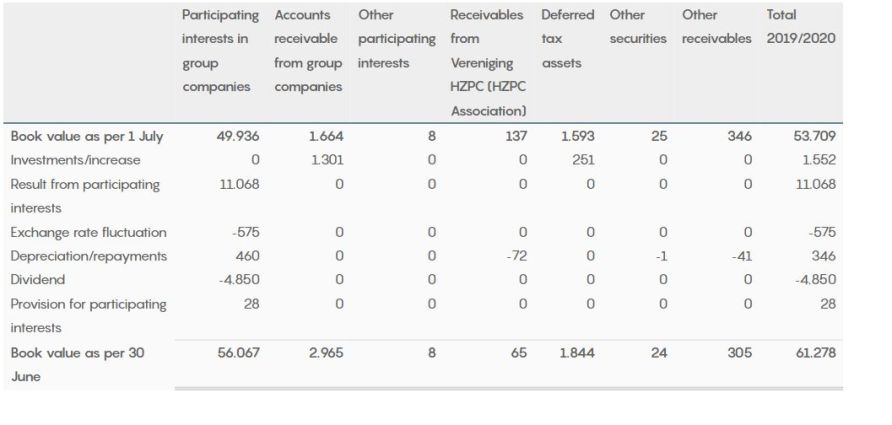
24. Financial fixed assets

The movement per category of financial fixed assets is as follows:

The repayments / depreciations on participating interests in group companies concern the movement in connection with the write-down of the receivables from participating interests with a negative book value.

The receivables from group companies have a term between 3 years and 8 years. Interest is charged on the receivable. This varies from 1% to 2.5%.

25. Other receivables and accrued assets

25. Other receivables and accrued assets
  30-jun-20 30-jun-19
Government grants to be claimed 19 0
Prepaid amounts 104 0
Status as of 30 June 123 0

26. Shareholders’ equity

The changes per category of shareholder equity is as follows:

  Issued capital Share premium reserve Other legal reserves Foreign currency translation reserve Other reserve Total 2019/2020
Book value as of 1 July 15.675 1.433 8.798 -604 28.248 53.550
Movements in financial year 2019/2020            
Dividend 0 0 0 0 -784 -784
Result of financial year 0 0 0 0 1.165 1.165
Exchange rate fluctuations 0 0 0 -575 0 -575
Other changes 0 0 -6.729 0 6.729 0
Status as of 30 June 15.675 1.433 2.069 -1.179 35.358 53.356

Issued capital

The authorised capital of the company amounts to EUR 50,000,000 (2018/2019 EUR 50,000,000) and is divided into 2,500,000 shares of EUR 20 each, with 783,725 ordinary shares being issued. The value of the paid and called-up capital amounts to EUR 15,674,500 (EUR 15,674,500 at the end of 2018/2019).

Share premium reserve

The share premium concerns the income from the issuing of shares in so far as this exceeds the nominal value of the shares (above par income).

Other legal reserves

Other legal reserves consist of a legal reserve for participating interests and the legal reserve for development costs. The legal reserve for participating interests relates to companies that are valued in accordance with the equity method. The reserve concerns the difference between the participating interests’ retained profit and direct changes in equity, as determined on the basis of the parent company’s accounting policies, and the share thereof that the parent company may distribute. As to the latter share, this takes into account any profits that may not be distributable by participating interests that are Dutch limited companies based on the distribution tests to be performed by the management of those companies. The legal reserve for development costs relates to the formed reserve of the not yet written off part of the capitalized development costs. The legal reserve is determined on an individual basis.

Foreign currency translation reserve

Exchange gains and losses arising from the translation of foreign operations from functional to reporting currency are recorded in this legal reserve. In the case of the sale of a participating interest, the associated accumulated exchange differences are transferred to other reserves.

Other reserves

It is proposed to the General Meeting to appropriate the result after taxes for 2019/2020 as follows: to add an amount of EUR 381,000 to the other reserves and to distribute the remaining amount of EUR 784,000 as dividend.

The movement of EUR 6,729,000 concerns the allocation from the legal reserve.

Proposal for result appropriation

It is proposed to the General Meeting to appropriate the result after taxes for 2019/2020 as follows: to add an amount of EUR 381,000 to the other reserves and to distribute the remaining amount of EUR 784,000 as dividend. EUR 1.00 is available per share certificate. This proposal is recorded in the balance sheet under the current liabilities.

27. Provisions

Provisions for participations

The composition and the course of the provisions in the financial year 2019/2020 are shown in the following overview:

  Total 2019/2020 Total 2018/2019
Status as of 1 July 554 1.495
Additions 582 0
Withdrawals -554 -941
Status as of 30 June 582 554

The provision relates to participations with a negative net equity value.

Other provisions

The following overview shows the movements in 2019/2020:

  Total 2019/2020 Total 2018/2019
Status as of 1 July 17 16
Additions 12 1
Status as of 30 June 29 17

The provision for anniversary liabilities is calculated on the basis of a 4% discount rate and taking the expected turnover in personnel into account.

28. Taxes and contributions

28. Taxes and contributions
  30-jun-20 30-jun-19
Corporate income tax to be paid 0 829
Payroll tax and social insurances 36 35
  36 864

29. Other debts and accrued liabilities

29. Other debts and accrued liabilities
  30-jun-20 30-jun-19
Wages and salaries to be paid  593   498 
Pension contributions  13   18 
Invoices to be received  279  196
Provision lawsuits 0  67 
Other amounts  146   145 
   1.031   924 

30. Share in result in participating interests after tax

This relates to the share in result the company and its subsidiaries has in participating interests of which EUR 11,215,000 (2018/2019: EUR 12,740,000) relates to group companies. The other part concerns results in minority interests amounting to EUR 147,000 negative (2018/2019: 727,000).

31. Other income and expenses after tax

The other result after tax concerns the regular costs of conducting holding activities. The costs concern personnel costs, other operating costs including legal costs, depreciation, impairments and interest income and expenses. For the 2019/2020 financial year, an impairment of EUR 8,879,000 has taken place on the developed ERP system.

Wages and salaries

Wages and salaries
  2019/2020 2018/2019
Gross staff wages 1.060 1.054
Employer’s social security contributions for staff 40 40
Pension premium 62 81
  1.162 1.175

Specific details for number of FTEs

Specific details for number of FTEs
  2019/2020 2018/2019
Management en administration 4 4

At HZPC Holding B.V. there were an average of 4 FTE in service, all working in the Netherlands (previous financial year 4 FTE).

Other explanatory notes

Financial instruments

In the normal course of business, the company uses financial instruments that expose the company to market, currency, interest rate, credit and liquidity risks. To manage these risks, the company has developed a policy, including the establishment of a system of credit limits and procedures to reduce the risks of unpredictable adverse developments in financial markets and thus the financial performance of the company.

Credit risk

The company incurs credit risk on loans and receivables recorded under financial fixed assets, other receivables and cash.

Liquidity risk

The Company monitors its liquidity position through successive liquidity budgets. The management will ensure that sufficient liquidity is available to meet the obligations. 

Interest risk

The Company incurs interest on interest bearing assets and liabilities. Both of these receivables and payables have agreed on variable rate interest rate agreements, which means that the Company is exposed to future cash flows. In order to limit the interest risk on the credit facility, a rent cap has been agreed as a mitigating measure.

Off-balance sheet assets and liabilities

  • The company has liabilities under operating leases and rent for an amount of EUR 37,000. Of this amount, EUR 26,000 has a term of less than one year. The remaining amount concerns an obligation for less than five years. The debt for rental and lease in accounting year 2019/2020 amounted to EUR 63,000.
  • The company has entered into a commitment for the new building in Metslawier for EUR 1.8 million. In 2019-2020, EUR 0.8 million had already been invoiced and the remaining commitment entered into at the end of the financial year was EUR 1 million.

Tax entity

Together with its subsidiaries within the Netherlands, the company forms a tax entity for corporate income tax purposes and valueadded tax. The standard conditions stipulate that each of the companies is liable for the tax payable by all companies belonging to the tax entity. The fiscal entity does not differ from the fiscal entity in the consolidated financial statement.

Remuneration of managing and supervisory director

A statement of the remuneration of the management has been omitted, pursuant to the provisions of Section 383 of Book 2, Title 9 of the Dutch Civil Code. The remuneration of Supervisory Board members amounts to EUR 98,000 (2018/2019: EUR 86,000).

Joure, 1 October 2020

The board:
G.F.J. Backx (CEO), statutair bestuurder
H. Verveld (CCO)
J.L. van Vilsteren (CFO)

The supervisory board:
M.J. Ubbens, voorzitter
C.J. Biemond
I. Frovola
M. Kester
M. Hommes-Gesink

Volgend hoofdstuk: Other information