1 - Economic risk
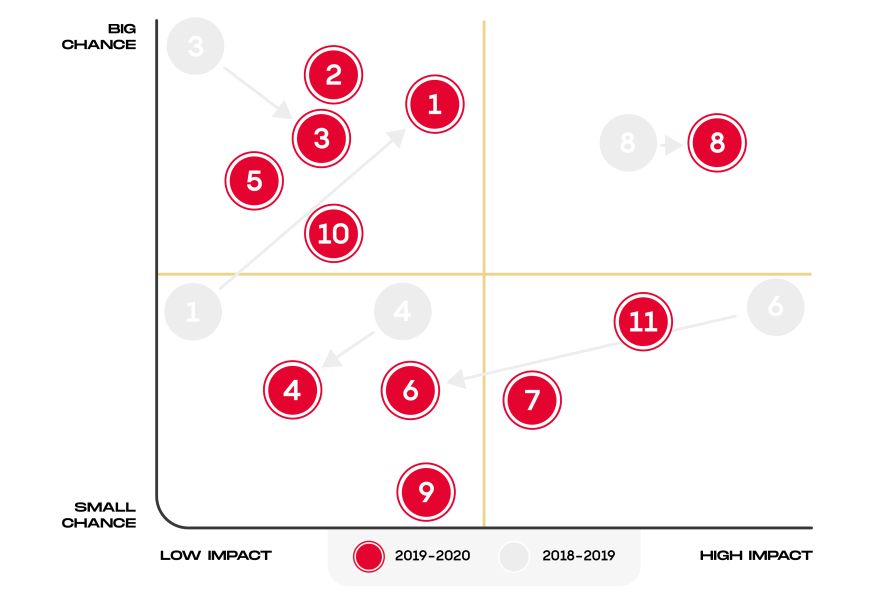
From an economic perspective, the situation has changed drastically. At the beginning of the year, there was worldwide growth, however we are now seeing a substantial downturn in economic activities across many regions. The low price of oil and the pandemic has dramatically changed the market situation in our most important export markets. This could well have an impact on our exports and, in turn, on the financial results for our company and growers.
2 - Political unrest
The level of political unrest has certainly not decreased, and specific political decisions have had a negative impact on sales. Last year we encountered delays in terms of receiving payments. Export opportunities to Russia were further limited. Our international scope mitigates these risks but they nevertheless need to be monitored.
3 - Currency fluctuations
There have also been strong fluctuations in exchange rates throughout the year. We have had to absorb the consequences of this decrease in exchange rates in emerging regions such as South Africa and Chile, but also in Russia. We have a relatively limited exposure to foreign currencies but the shift was significant and impacted upon the company’s results. We were, however, able to compensate for this by selling larger volumes in these markets.
4 - Talent management
The growth which was forecast made the necessity of attracting talent a matter for attention. Work on the image and communications of HZPC Holding is taking place to assist in this. Despite the squeeze on labour market conditions,
we have been reasonably successful in attracting the right talent. We realise that our mission and vision appeal to talented people. In the coming years, we expect the probability and impact of this risk to reduce, thanks to a broader market and more limited growth in the number of employees.
5 - Protection products
As certain crop protection products can no longer be used, the challenge for growers increases in relation to the cultivation and storage of seed potatoes. This challenge is set to expand in the coming years. This risk is managed by alternative measures and guidance. A great deal of work is also focussed on introducing varieties that reduce the use of crop protection agents. And this takes time. Societal pressure to change legislation more quickly also seems to be increasing. As a result, there is greater pressure to adapt our variety portfolio quicker. The options to do so, however, are limited. Consequently, we could see the impact of this risk increase over the coming years.
6 - Provision of information
Provision of information and protection: growth and further digitisation have increased the dependence on IT systems.
Last year, we reported that the planned implementation of a new Enterprise Resource Planning (ERP) system constituted an additional risk with a high impact and reasonable probability. Over the past few years, we have incurred very high costs in relation to implementing a new ERP. These were capitalised in accordance with accounting standards. However, in October of this year, we halted this project as the risk was becoming too significant for the organisation and our growers. We must, in turn, absorb the costs in our results. These costs were incurred for the project over the past few years. The risk had a major impact on our results and the probability and impact became a reality.
New steps are now being taken towards a new, integrated system with an adequate infrastructure and back-up facilities. The last project was extensively evaluated and modifications were made in terms of our preparation and working methods. The project will be restarted over the coming years. The need remains to replace the old customised working system and make it more resilient for the future. Once the old ERP system has been strengthened and upgraded, we expect to be able to manage for the next three years with the old, customised system. In the graph, we have therefore reduced the risk for the coming year to ‘small probability’ and ‘low impact’ because we will spend a great deal of time on preparation, but are not yet ready for implementation.
As well as a new ERP system, we will also work on improved security within the IT infrastructure. This is being tested by means of pen tests and employee training. This is vital as there are more threats than ever from the outside world, in this type of environment. The tests and maintenance that has been carried out over the past year have reassured us that the chance and impact on our organisation are reduced.
7 - Seed potato diseases
The seed potato market is a global market. Our sales can be influenced by phytosanitary impediments and political factors. Disease risk plays an important part in breeding seed potatoes. Quarantine diseases in particular have a large influence on the availability of seed potatoes. The discovery of a quarantine disease at our breeding station or in our production area could seriously delay the development of new varieties and the sale of varieties which have already been produced. This year, there are no specific incidences or reasons to change the status of this risk.
8 - International commercial operations
Our operating profit is subject to credit risks. The financial position of the various buyers in politically unstable areas has definitely not become any less difficult or any easier to assess. Over the coming period, the payment risk will increase due to the economic crisis. This remains a high risk, which could also have a serious impact. We are noticing, particularly in the overseas markets, that it is taking longer to be paid. Where possible we have taken the following mitigating measures to counter this:
We regularly use safeguards such as advance payments, LCs and bank guarantees.
Credit limits are actively monitored throughout the season
New deliveries for the new season are rarely permitted until debts from the previous season have been paid.
9 - Complying with laws and regulations
HZPC Holding and her subsidiaries may be held responsible for any liabilities arising out of non-compliance with laws and regulations. As HZPC Holding, we do business in more and more countries that have juridical compliance processes with which we have to comply. The UK Bribery Act is an example of one such law with which HZPC Holding and also other international companies have to comply. We are fully aware that the risk of non-compliance with laws and regulations can damage our reputation and lead to serious legal consequences. This year, the introduction of the GDPR has been given the necessary attention. We hope to control this risk more effectively with the aforementioned ERM system.
10 - Substitution risk
There is a chance that substitute products may be developed, such as competing varieties or the production of earlier and/or better potatoes from seed, but it does not represent a high risk in the short term. In the long term, this could have a huge impact on our business model. That is why we are working on hybrid varieties and potatoes grown from seed. We see no reason to change this position in the coming years.
11 – Pandemic
In the last financial year, the COVID-19 pandemic had a limited impact on our result. A few contracts were renegotiated and this had a limited impact on sales. The costs were somewhat lower as we were able to pay fewer visits to customers and partners. The corresponding impact in the long term is hard to predict in terms of value. We are also confronted with an increasing debtor position and an increasing need for liquidity.
In addition to the already known consequences of the COVID-19 outbreak and related government measures, the current macro-economic uncertainty is causing a disruption to the global economy. At the same time, uncertainty remains about a possible second wave that could affect us and our export countries. Management remains uncertain about the long-term consequences for HZPC. The management has performed various analyses to determine what the impact could be on HZPC's liquidity in the event of a decrease in revenue under different scenarios. The management continuously assesses the available information and the risks in order to take appropriate measures.