Compliance

9.1 Corporate governance & personal details

HZPC Holding is a two-tier board company with an Executive Board and an independent Supervisory Board (RvC). The Supervisory Board appoints the members of the Executive Board.

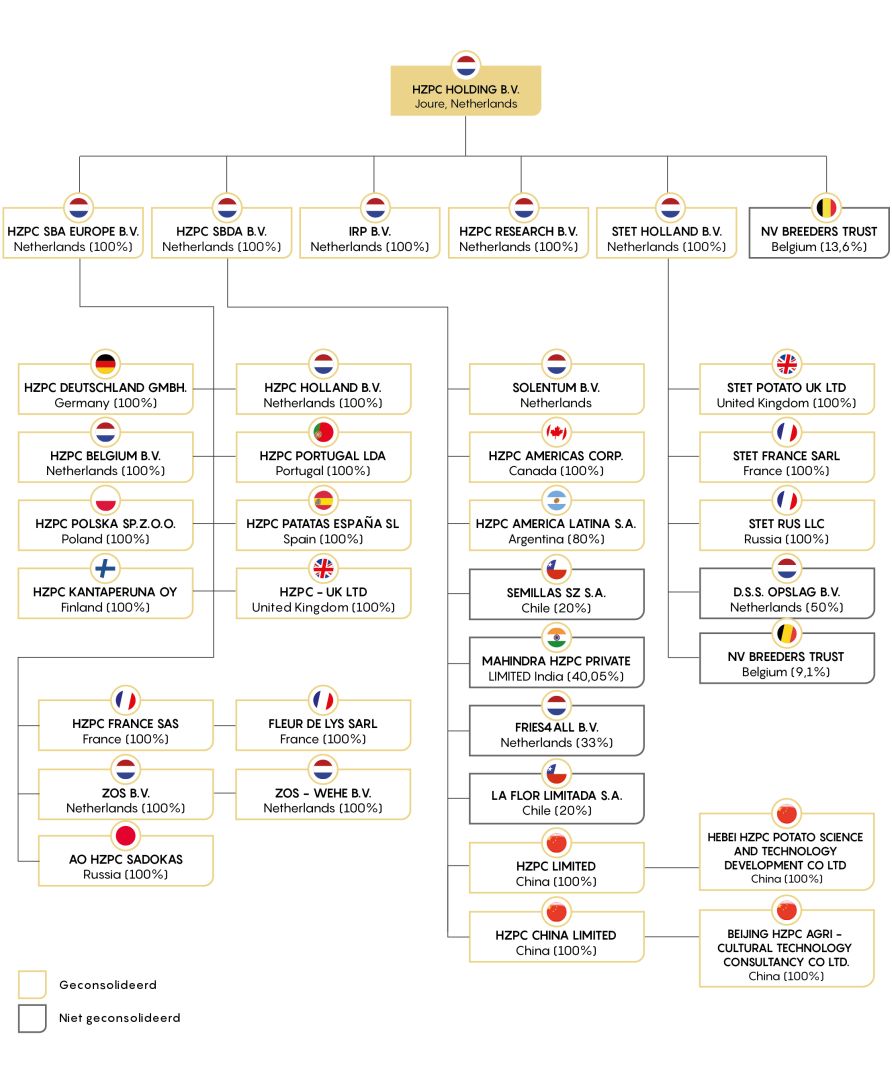
The Executive Board informs the Supervisory Board about operations, consults with the Supervisory Board on all important issues, and presents important decisions to the Supervisory Board for approval. The Strategic Business Area Europe, the Strategic Business Development Area, STET Holland, IPR and HZPC Research & Development are managed by the Executive Committee.


The Supervisory Board supervises and monitors the policy of the Executive Board and the day-to-day operations, and advises the Executive Board. The members of the Supervisory Board are appointed by the General Meeting of Shareholders (GMS) upon recommendation by the Supervisory Board.

The General Meeting of Shareholders is convened by the Board of ‘Vereniging HZPC’ (Association HZPC), which holds 100 percent of the shares. The law and articles of association governing the company set out the General Assembly of Shareholders' authoritative powers. In addition, the Executive Board must present specific decisions to the General Meeting of Shareholders for approval.

Association HZPC has certified all the shares. Only (former) growers, (former) breeders and (former) members of staff may purchase and hold certificates. HZPC Holding is, therefore, quite literally a company of growers, breeders and employees and they all have a voice in the direction of the company. They finance the business with risk capital. Certificate holders can become members of the Association.

The general members’ meeting of Association HZPC elects and nominates the Board. The management of the Association requires approval of the members for a number of decisions taken.

9.2 Personal details of the management structure as of 30 June 2020

Supervisory Board

M.J. Ubbens, voorzitter Groningen
C.J. Biemond Godlinze
I. Frolova Utrecht
M. Hommes-Gesink Lauwerzijl
M. Kester Bussum

HZPC Holding B.V.

Executive Board

G.F.J. Backx Chief Executive Officer
H. Verveld Chief Commercial Officer
J.L. van Vilsteren Chief Financial Officer
 

Executive Committee

G.F.J. Backx Chief Executive Officer
L. Escalon Director SBA Europe B.V.
R.P. Graveland Director HZPC Research B.V. and IPR B.V.
P.C. Ton Director STET Holland B.V.
H. Verveld Director SBDA B.V.
J.L. van Vilsteren Chief Financial Officer
 
Participations
HZPC IPR B.V. R.P. Graveland
HZPC SBA Europe B.V. L. Escalon
HZPC SBDA B.V. H. Verveld
HZPC Research B.V. R.P. Graveland
STET Holland B.V. P.C. Ton

HZPC SBA Europe B.V.

Director
L. Escalon Director
 
Management of participations
HZPC Deutschland GmbH R. Möller
HZPC France SAS C. Gauchet
HZPC Holland B.V. L. Escalon
HZPC Belgium B.V. F. van der Werff
HZPC Kantaperuna OY M. Kauppinen
HZPC Patatas España S.L. J. Luis Marti
HZPC Polska Sp. z.o.o. T. Jardzioch
HZPC Portugal Lda P. Simoes
AO HZPC Sadokas  P. Bemelmans
HZPC UK Ltd. C.R. Baker
ZOS B.V. F. van der Werff
 
HZPC Holland B.V. Works Council

G. Bloembergen

President
E. Meinsma Vice president
L. Gommers Secretary
W. Meijer Member
P. Kreijger Member
T. van der Wal Member
D. Woertink Member
S. Stevens Member
S. Potijk Member

HZPC SBDA B.V.

Director
H. Verveld Director
 
Management of participations
Solentum B.V. E. Bakker
HZPC América Latina S.A. I. Ramallo
HZPC Americas Corp. J. Scramlin
HZPC Limited H. Verveld
HZPC China Limited H. Verveld

STET Holland B.V.

Director

P.C. Ton Director
 
Management of participations
STET Potato UK P. Hewett
STET France Arl. T. Rondeaux
STET Russia LLC. P.C. Ton, S. Voychik

N.B.
The company has not set a specific goal to appoint women to Board roles or other positions. It does, however, aim to realise greater diversity in this context.

9.3 Risk Management

Enterprise Risk Management

In the coming years, as part of our strategy, we aim to further improve professionalism with respect to risk management. That is why we have started creating Enterprise Risk Management (ERM). Over three years, we aim to pay particular attention to risk management and ensure this is integrated more effectively into and reinforced within the HZPC Group.

In so doing, HZPC will continue to grow across various regions, segments and business models. This also relates to risks and we believe it is necessary to strengthen this area internally. This all begins with clear (internal) processes and procedures. Our external environment is also demanding increasing transparency regarding our activities.

A greater focus on internal processes and compliance may perhaps give the impression that entrepreneurship is relegated to second place, but that is not the case. Just like growing from a small car to a lorry; if we want to move faster, we have to ensure we have more effective brakes and a better dashboard. We aim to achieve this by creating ERM.

With our risk management activities, we will try to offer greater certainty with respect to realising trade goals and fulfilling our obligations to our customers, shareholders, employees, and society as a whole.

Doing business inherently involves taking risks. By taking balanced risks, we strive to continuously build on being a financially sound and sustainable company. Risk management is therefore an important element of our corporate governance and strategy development.

Extra risk

The financial year 2019-2020 is one to remember. The year 2020 will go down in history as the year of COVID-19, or the coronavirus. What began with a hotbed of infection in Wuhan, China, became a global pandemic. Many companies did not have the pandemic in their risk table. For us, it had an impact in several ways. The impact on our sales this year was limited; most seed potatoes were sold before the outbreak of the virus. 

What the impact will be in the coming year depends on how the pandemic develops and what measures different areas are taking. However, we are part of the food chain, which means that our contribution will remain operational in a particular country for as long as possible. The coronavirus creates new challenges and a new way of working. Working from home was (and is) the norm. For our employees this was a whole new experience. However, worldwide they were creative to still serve their customers.
The work was done from home wherever possible. On the different offices adjustments were made to be able to work from a suitable distance.

So far, the financial impact on the income and cost side will be minimal. However, we are confronted with an increasing debtor position and an increasing need for liquidity.  Concrete agreements have been made with a number of customers regarding payment terms and debtor management is receiving extra attention.

We think, from now on, it’s vital to include the pandemic in our risk table as risk 11.

Risk factors

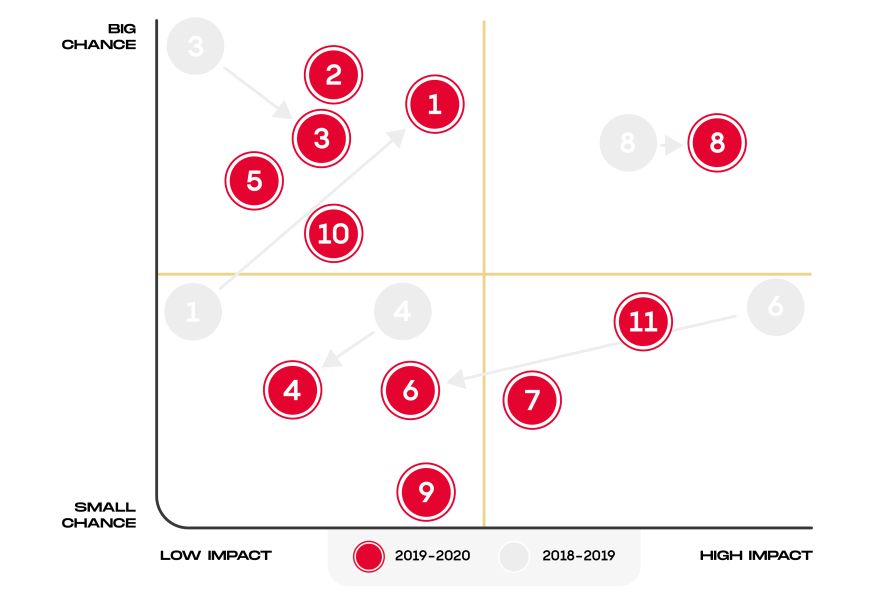
The following table indicates the 11 most important risk factors. The table is used to indicate the likelihood of a risk occurring and the possible impact of the risk on our strategic ambitions. We also provide mitigating measures for the square 'high impact' and ‘big chance'. The overview is not intended to be an exhaustive list but offers details of what we currently see as our biggest risks.

The following specific risks arose over the last year:

1 - Economic risk
From an economic perspective, the situation has changed drastically. At the beginning of the year, there was worldwide growth, however we are now seeing a substantial downturn in economic activities across many regions. The low price of oil and the pandemic has dramatically changed the market situation in our most important export markets. This could well have an impact on our exports and, in turn, on the financial results for our company and growers.

2 - Political unrest
The level of political unrest has certainly not decreased, and specific political decisions have had a negative impact on sales. Last year we encountered delays in terms of receiving payments. Export opportunities to Russia were further limited. Our international scope mitigates these risks but they nevertheless need to be monitored.

3 - Currency fluctuations
There have also been strong fluctuations in exchange rates throughout the year. We have had to absorb the consequences of this decrease in exchange rates in emerging regions such as South Africa and Chile, but also in Russia. We have a relatively limited exposure to foreign currencies but the shift was significant and impacted upon the company’s results. We were, however, able to compensate for this by selling larger volumes in these markets.

4 - Talent management
The growth which was forecast made the necessity of attracting talent a matter for attention. Work on the image and communications of HZPC Holding is taking place to assist in this. Despite the squeeze on labour market conditions,

we have been reasonably successful in attracting the right talent. We realise that our mission and vision appeal to talented people. In the coming years, we expect the probability and impact of this risk to reduce, thanks to a broader market and more limited growth in the number of employees.

5 - Protection products
As certain crop protection products can no longer be used, the challenge for growers increases in relation to the cultivation and storage of seed potatoes. This challenge is set to expand in the coming years. This risk is managed by alternative measures and guidance. A great deal of work is also focussed on introducing varieties that reduce the use of crop protection agents. And this takes time. Societal pressure to change legislation more quickly also seems to be increasing. As a result, there is greater pressure to adapt our variety portfolio quicker. The options to do so, however, are limited. Consequently, we could see the impact of this risk increase over the coming years.

6 - Provision of information
Provision of information and protection: growth and further digitisation have increased the dependence on IT systems.

Last year, we reported that the planned implementation of a new Enterprise Resource Planning (ERP) system constituted an additional risk with a high impact and reasonable probability. Over the past few years, we have incurred very high costs in relation to implementing a new ERP. These were capitalised in accordance with accounting standards. However, in October of this year, we halted this project as the risk was becoming too significant for the organisation and our growers. We must, in turn, absorb the costs in our results. These costs were incurred for the project over the past few years. The risk had a major impact on our results and the probability and impact became a reality.

New steps are now being taken towards a new, integrated system with an adequate infrastructure and back-up facilities. The last project was extensively evaluated and modifications were made in terms of our preparation and working methods. The project will be restarted over the coming years. The need remains to replace the old customised working system and make it more resilient for the future. Once the old ERP system has been strengthened and upgraded, we expect to be able to manage for the next three years with the old, customised system. In the graph, we have therefore reduced the risk for the coming year to ‘small probability’ and ‘low impact’ because we will spend a great deal of time on preparation, but are not yet ready for implementation.

As well as a new ERP system, we will also work on improved security within the IT infrastructure. This is being tested by means of pen tests and employee training. This is vital as there are more threats than ever from the outside world, in this type of environment. The tests and maintenance that has been carried out over the past year have reassured us that the chance and impact on our organisation are reduced.

7 - Seed potato diseases
The seed potato market is a global market. Our sales can be influenced by phytosanitary impediments and political factors. Disease risk plays an important part in breeding seed potatoes. Quarantine diseases in particular have a large influence on the availability of seed potatoes. The discovery of a quarantine disease at our breeding station or in our production area could seriously delay the development of new varieties and the sale of varieties which have already been produced. This year, there are no specific incidences or reasons to change the status of this risk.

8 - International commercial operations
Our operating profit is subject to credit risks. The financial position of the various buyers in politically unstable areas has definitely not become any less difficult or any easier to assess. Over the coming period, the payment risk will increase due to the economic crisis. This remains a high risk, which could also have a serious impact. We are noticing, particularly in the overseas markets, that it is taking longer to be paid. Where possible we have taken the following mitigating measures to counter this:

  • We regularly use safeguards such as advance payments, LCs and bank guarantees.

  • Credit limits are actively monitored throughout the season

  • New deliveries for the new season are rarely permitted until debts from the previous season have been paid.

9 - Complying with laws and regulations
HZPC Holding and her subsidiaries may be held responsible for any liabilities arising out of non-compliance with laws and regulations. As HZPC Holding, we do business in more and more countries that have juridical compliance processes with which we have to comply. The UK Bribery Act is an example of one such law with which HZPC Holding and also other international companies have to comply. We are fully aware that the risk of non-compliance with laws and regulations can damage our reputation and lead to serious legal consequences. This year, the introduction of the GDPR has been given the necessary attention. We hope to control this risk more effectively with the aforementioned ERM system.

10 - Substitution risk
There is a chance that substitute products may be developed, such as competing varieties or the production of earlier and/or better potatoes from seed, but it does not represent a high risk in the short term. In the long term, this could have a huge impact on our business model. That is why we are working on hybrid varieties and potatoes grown from seed. We see no reason to change this position in the coming years.

11 – Pandemic
In the last financial year, the COVID-19 pandemic had a limited impact on our result. A few contracts were renegotiated and this had a limited impact on sales. The costs were somewhat lower as we were able to pay fewer visits to customers and partners. The corresponding impact in the long term is hard to predict in terms of value. We are also confronted with an increasing debtor position and an increasing need for liquidity.

In addition to the already known consequences of the COVID-19 outbreak and related government measures, the current macro-economic uncertainty is causing a disruption to the global economy.  At the same time, uncertainty remains about a possible second wave that could affect us and our export countries. Management remains uncertain about the long-term consequences for HZPC. The management has performed various analyses to determine what the impact could be on HZPC's liquidity in the event of a decrease in revenue under different scenarios. The management continuously assesses the available information and the risks in order to take appropriate measures.
Lees meer

9.4 Results, investments, financing

Results

Turnover of EUR 360.6 million was recorded in the past year. The gross margin of the organisation increased to EUR 65.3 million. The net profit before tax is greatly reduced by the major write-off with regard to the ERP project and amounts to EUR 3.2 million, net profit after taxes amounts to EUR 1.2 million.

Investments

This year, together with our joint venture partner, we have provided additional capital to Mahindra-HZPC in order to guarantee growth and continuity. We have also invested in our R&D centre as it had outgrown its location. Our international mini-tuber and tissue plant production in China and Russia have also been expanded. These extra investments took place alongside our annual investments in ICT and R&D. Our invested capital at the end of the financial year 2019/2020 was EUR 29.6 million, a decrease of EUR 6.2 million. This was principally caused by the ERP project and other investments. We are also investing in the further expansion of our Research facilities and developing our Tissue Culture and mini-tuber facilities. In the coming years, we must invest in updating our ERP package, including the corresponding software.

We make ongoing investments in our personnel and do not expect an increase in our staffing levels.

Financing

The financing structure has not been affected by any major changes this year. However, corona has meant that we have had to use our allowances and we have expanded these facilities with the banks. The need for working capital has increased. This is primarily caused by an increase in our debtors and more advanced payments by our growers. The business has therefore expanded the facility with the bank in order to finance the growing need for working capital. The solvency of the business reduced from 41.4 percent in 2018/2019 to 37 percent in 2019/2020. The current ratio is 1.3 and the quick ratio is 1.2.

9.5 Share certificates

HZPC Holding has issued 783.725 shares with a nominal value of 20 euro. The HZPC Association owns 100% of the shares and has issued depositary receipts for all shares. The holders of depositary receipts form a private group and they must meet specific qualifications. All holders of depositary receipts have or have had a business agreement with HZPC Holding in the past.

Connecting Growers
Twenty years ago, almost all certificates were in the hands of active growers. This has now fallen to around half. This is due to the fact that many growers are no longer actively involved in growing, but hold onto their certificates and rarely offer them for sale. These certificates are then bought by very few active growers.

The Executive Team, in consultation with the Supervisory Board (SB) and the Board of Association HZPC, decided on a method for ensuring that more certificates end up in the hands of active growers. To this end, the SB and the Board proposed the creation of the Connecting Growers programme to the Executive Team. For more information go to:  www.hzpc.com/cg.

Trading day
Twice every financial year, in November and May, the Association organises a stock exchange trading day. During these days, as well as the certificate scheme for staff, HZPC will also buy certificates for the Connecting Growers programme.

Association HZPC was the Stockholder and Captin was the market supervisor for the stock exchange trading days in November 2019 and May 2020. Captin also provides the administration for the certificates.

The certificate holders receive information about the company via press releases, the annual report and the HZPC Holding website (www.hzpc.com). In addition, Dutch certificate holders receive the company’s client magazine ‘Ruggespraak’.

  2015/2016 2016/2017 2017/2018 2018/2019 2019/2020
Profit per share certificate (x EUR 1) € 8.93 € 10.82 € 6.00 € 11.93 € 1,49
Dividend per share certificate (x EUR 1) € 5.75 € 7.00 € 4.00 € 7.75 € 1,00
Dividend as % from the net result 64% 65% 67% 65% 67%
           
Price as of 30 June (x EUR 1) € 136.90 € 165.65 € 200.00 € 162.00 € 131,25
Dividend as % from that rate 4.20% 4.23% 2.00% 4.78% 0,76%
Return to shares (x EUR 1) € 23.75 € 35.75 € 38.35 € (30.25) € (29,75)
           
Return to shares % of the price (as of 30 June van previous year) 21.00% 26.11% 23.15% -15.13% -18,36%

Group structure

Volgend hoofdstuk: Report of the Supervisory Board